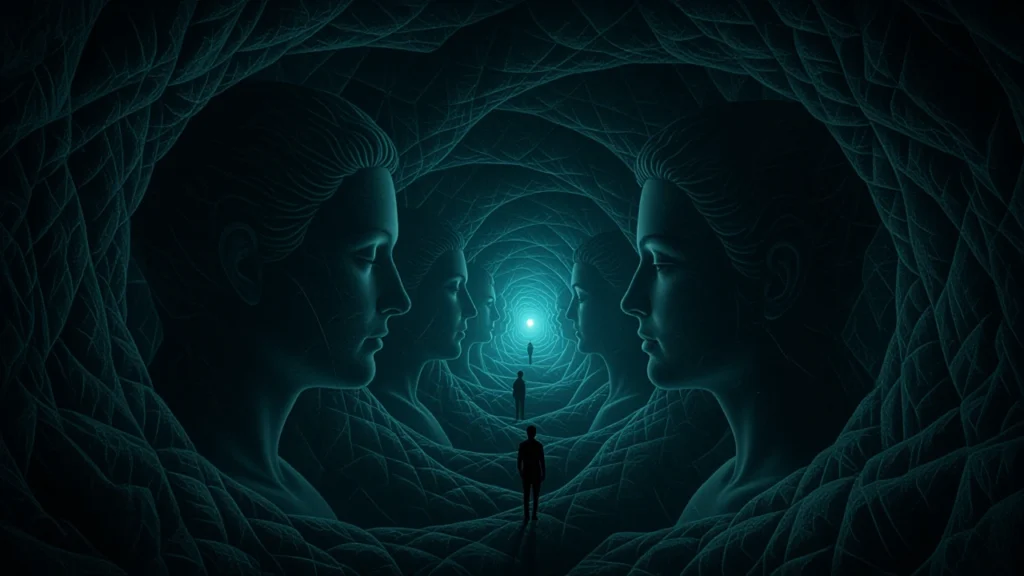
I like to say that there is nothing spiritual about spirituality.
I don’t know exactly what spirituality is. And honestly, anyone who claims to know is automatically suspicious to me.
Nevertheless, I feel that the word “spirituality” is used today for everything except what might be interesting about it. For some, it’s energies, vibrations, beings, the higher self, God, and the universe trying to tell them something. For others, it’s just a remnant of religious thinking, dull creationism, or various esoteric rituals and doctrines that haven’t yet been amputated by rationality. Neither of these resonates with me very much.
If I had to say what spirituality is for me (if anything), it would be something much simpler, more mundane, and at the same time more unpleasant. For me, spirituality is not faith. Nor is it a worldview. It is not identity. It is not technique either. It is a very practical experience of things simply happening. Without me owning them. Without me controlling them. Without anyone being there to control them.
If I meditate, then I meditate. If I perform a ritual, then I perform a ritual. If I don’t feel like doing anything at all and I feel that this whole “search” is one big hallucination of the ego, then that’s what happens. I have no control over it. And that’s why I don’t need any faith or rational conclusions.
Esotericism, meditation, and my approach
The world has practically never made sense to me. It has never formed a consistent narrative in which it would make sense to achieve something, change something, believe in something, or get somewhere, as I elaborated on in my previous article. It has always been rather broken, leaky, full of cracks. Every meaning in it always fell apart after a while, and every opinion, ideology, or life mission simply stank to me. As a typical nerd with various hyperfocuses, I realized this at an early age—if something interested me and I thought, “This is it,” “This is the path I want to take,” it always fell apart after a while. Whether it was studying dinosaurs, geography, airplanes, or religions. Once the hyperfocus came, and once it went away. And then again.
However, I couldn’t reject the game of interest and (hyper)focus based on some intellectual discovery; it simply continued. Hyperfocuses simply happened without my control, regardless of my feeling that “this is it” (and regardless of my nihilistic conclusions such as “nothing makes sense when everything is fleeting”). And maybe they still happen.
During my later adolescent and post-adolescent wanderings through daily meditation, measuring my brain waves with Muse EEG equipment, and learning about tantric rituals in Vajrayana Buddhism and Hinduism in India, I often came across new hyperfocuses — teachings that made sense to me and that I wanted to practice, but something always happened just before it began to shape me more than superficially. Not fear. More like a quiet inner alarm. A feeling that if I took one more step, something would begin to possess and enslave me.
I often feel a strange tension between what seems “deep” and what, after a while, begins to seem like bullshit. That’s why I think spirituality is often unspiritual—it’s a field that can very easily go wrong. Not because there is no depth to it, but because it too quickly becomes a system, a method, a commitment, or—perhaps most problematically—hope. That’s when I feel resistance, and I can’t do anything about it. It’s not my opinion, but rather a physical reaction.
And this resistance often takes a very specific form for me. As soon as I pick up a mala, start practicing something, whether Buddhist, Hindu, or something else, reciting mantras, it almost always ends the same way. First, there is intensity. The feeling that something is happening. Then tension. Stress from having to repeat it to be consistent. The feeling that I have committed myself to something. And finally, the mala ends up torn, thrown in the trash, or discarded somewhere in the jungle.
Not as a conscious symbolic act. Not as some kind of ritualistic dramatic gesture. More like when the body angrily rejects something that is not good for it.
Many people, especially white atheists, don’t understand any of this. It seems religious to them. They know me as a nerd. They don’t understand why I perform rituals and other “esoteric” practices. I’m not a believer, am I?
At most, I believe that there is nothing to believe in and no one who believes. There is only action. If you go to meditate, meditation happens. If you go to do some esoteric ritual, it happens. During that, certain experiences may or may not arise. And that’s it. I have no control over it. I don’t need to believe in it.
What if I worked with some deity (yes, I also did sadhanas with deities in Hinduism and Buddhism)? After all, deities are just fictional characters, right?
Yes—deities are fictional characters. Just like me. Deities are no more real than The Simpsons or Donald Duck. But they are archetypes of human consciousness. Certain patterns that have emerged because people have invested attention, emotion, fear, desire, and mental effort in them for centuries.
When I recite the mantra Kali and feel something fierce, uncompromising, and transcendental, there is nothing supernatural about it. No energy from another dimension came to me. I simply tune into the memetic imprint associated with this archetype (as I wrote in my article on memetics). It’s like when I’m walking down the street, I smell food from a fish stall, and the thought “Hmmm, fish…” pops into my head. Homer Simpson would say exactly the same thing.
It’s not esotericism. It’s memetics. This is how everything works in the mind.
Robert Anton Wilson often mentioned an experiment from the field of Discordianism and his work with the concept of reality tunnels. It was not his own experience, but an anonymized example he used to illustrate the mechanism, not as an authority.
In it, a man systematically used sexually intense states over a long period of time to maintain a single mental framework—the idea that he was not communicating with his wife, but with a non-human intelligence, an “extraterrestrial being.” Not as a game or an erotic fantasy, but as a serious experiment. After a while, spontaneous perceptions and feelings of responses began to appear, which no longer seemed like a consciously created idea, but something autonomous.
Wilson did not offer this as proof of the existence of extraterrestrials, but as an extreme example of the plasticity of the brain: if you give it enough attention, emotion, and repetition, it will internalize virtually any model of reality. Same mechanism. Different content.
And what is important — all content will die out if it has nowhere to be played. As aghori told me in one of my previous articles — even gods must die. Because they are finite. Everything that arises in the mind has its end. Even gods. Even truths. Even systems that pretend to be eternal.
But people don’t want to hear this. Most of them settle down somehow. Some in religion, some in new age talk about energies, others in skeptical atheism. Each of these attitudes provides a certain kind of comfort — a framework in which one can function without constant friction. Rituals and skepticism act as stabilizers.
And sometimes I find myself in that same comfort zone. Other times it falls apart. Without any dramatic reason. Without any lesson. Suddenly there is nowhere to stand. There is no position left to defend — neither sense nor nonsense. And this, too, is just another state that appears and disappears. Sometimes I feel that everything is bullshit and there is no point in doing anything spiritual. Other times, something is done. I don’t choose either. Both sense and nonsense are illusions to me. They are just more actions that happen.
And when someone says they are an atheist and believe in nothing, I find it just as ridiculous as religious fanaticism. Atheists, agnostics—they all pretend that their position is the result of intellectual choice and evidence. But the human mind doesn’t work that way. The mind works on memes. We don’t choose our beliefs. We don’t choose our identity. Free will doesn’t exist because there’s no one here who has it. There is only will. Wild. Shared. Swept along by circumstances.
Gurus and UG Krishnamurti
That is why I generally have a strong aversion to gurus and other “spiritual” authorities. To people who claim to know. To those who take on the role of someone who has a map, instructions, or at least the right direction. Whenever a guru appears, hierarchy, dependence, projection, and hope appear as well. And with them, the possibility of manipulation—subtle or brutal. I hate it. Not morally. More physically. My body recoils before I even have time to form an opinion.
And yet—if I’m being honest—there is one person I mention deliberately in this text. Not because he is an exception to the guru system. But because he systematically broke and trolled that system.
The only person I encountered in my wanderings through “spirituality” who seemed authentic to me in all this was UG Krishnamurti. And that’s precisely because he gave me absolutely no hope. He offered no path. No solution. No system. Not even any understanding that could be sustained.
UG did not make spirituality better. He gave it the middle finger. He shattered the imaginary seeker, shattered questions, shattered the need to get somewhere. He did not offer “truth,” but systematically destroyed all mental constructs that claimed to be truth. Including spirituality itself. Including enlightenment. Including the idea that there is some state that can be reached if one does enough of the right things.
There was nowhere to go with him. And no one to go with. And that was the most radical thing about him.
UG openly said that everything is bullshit. And that we can’t escape bullshit even when we know that everything is bullshit. That even this knowledge is just another mental movement. Another game of the nervous system. No redemption. No final full stop. No “aha” moment that would wrap it all up.
And that’s why I consider him someone everyone should listen to — whether they’re interested in spirituality or not. Whether they’re religious, atheist, skeptical, or somewhere in between. UG offers no comfort. He offers no identity. He offers no story to hide behind.
Just the bare, uncomfortable possibility that there is nothing to solve. And no one to solve it.
And if there is anything liberating about it all, it is that even this may not be true. Even this cannot be grasped. Even this cannot be turned into a teaching. Even UG must die. Just as gods must die. Just as all the worlds we create in our minds must die.
And maybe that’s okay.