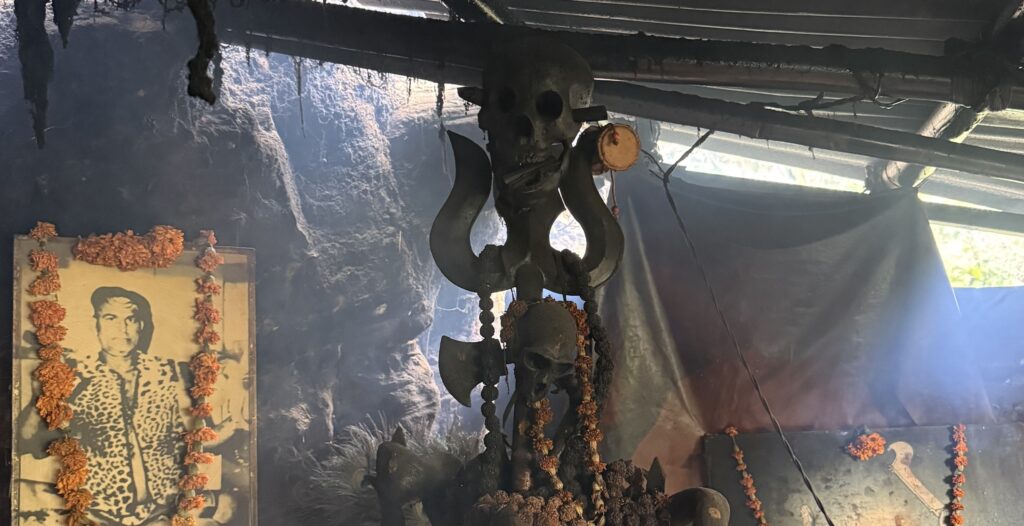
It is always better to live with reality, because otherwise, without fail, reality will come to live with you.
– The Aghori Vimalananda (Svoboda, R.E., 1993. Aghora III: The Law of Karma. C.I.M.O.T.I.)
Another pseudo-spiritual phrase? Perhaps. However, some words are not just spoken, but lived. I understood the authenticity of this sentence when I met Aghori in person. Not Vimalananda, but another gentleman at Pashupatinath Temple in Kathmandu.
And that’s exactly what this article is about. About the few days I spent with a man who could be called my “mentor” in a discipline whose exact name is questionable. Perhaps in the discipline of nothing specific.
Who are Aghoris?
If you’ve come across any European or American YouTuber who has traveled around India and wanted to make a really cool report, you’ve definitely come across the Aghoris – one of the most extreme and mysterious branches of Shaivism. Aghoris are ascetics who have embarked on a path that most people consider morbid, disgusting, crazy, or incomprehensible. Their goal is to break through all social, religious, and psychological boundaries—not to shock and troll, but to allegedly reach the original, unlimited essence of consciousness in the shortest possible way.
Aghoris believe that everything in existence is a manifestation of the same deity—Shiva. Good and evil, pure and impure, love and death. That is why they deliberately enter places and situations that ordinary people fear: crematoriums, ashes, darkness, death, human bones, corpses, feces, poisons, and everything else imaginable. They do not run away from them—on the contrary, they face them head-on.
The word Aghori itself consists of two parts:
- “A” – negation, denial
- “ghora” – in Sanskrit, it means “threatening,” “terrible,” “frightening,” something that evokes revulsion or horror
Aghori literally means “one who is not frightening” or “one who denies horror.” However, this does not mean that horror as such does not exist—it only means that, in their view, nothing is inherently unclean, repulsive, or evil. Horror is merely a human construct. And the Aghori reject it as an illusion.
Their rituals are shrouded in many myths and legends in India and Nepal. The truth is, however, that some of them drink and eat exclusively from human skulls, meditate next to dead bodies, smear themselves with ashes from cremations, eat human flesh, drink their own urine, eat shit, and so on.
The Aghori claim that only when a person enters into what they hate or fear can they understand the true unity of everything.
Therefore, there is no place for moralizing in their philosophy. There is no room for “good” and “evil.” There is only one thing—the truth, which, according to them, is always right in front of our eyes, only covered by cultural sediment, customs, fear, and our comfort zone.
First and foremost, the Aghoris are not tourist attractions for cool YouTube videos. They are ordinary people who have decided to burn everything that can be burned in a human being—including what others consider to be individual identity or ordinary human dignity.
That is why meeting them often feels strange – like coming into contact with someone who is the living, concentrated embodiment of a certain vibe that only people touched by emptiness, death, and complete freedom from everything that holds ordinary people together can feel.
What preceded Pashupatinath, life, and everything else
And what does all this have to do with me? Maybe nothing at all. But I know for sure that ever since I entered puberty, the world has seemed strangely empty to me. Not as a place of flesh and blood, but rather as a backdrop made of plastic that only shines until you look at it more closely. The people around me acted as if there was some kind of solid reality, but to me it all seemed more like a performance in which everyone was given a role and then stuck to it for fear that without it the scene would fall apart.
I didn’t take it as if I had some mystical insight into the nature of existence — it was more of a feeling that everything was crap because the world is somehow artificial, everything has a strange synthetic surface that tries to hide how confused people are. And in the midst of it all, I didn’t know what was real, so I had to start looking for it myself.
In elementary school, I had a mix of nerdy interests and hyperfocus on all kinds of random topics, stubbornness, and a fascination with individual freedom. Libertarian ideas, resistance to authority, the feeling that rules are arbitrary — all of this shaped me, but not in a very intellectual or theoretical way. Rather, they were an engine that gave me a sense of belonging, that I had my “own truth” when nothing else made sense. While others were dealing with the usual childhood worries, I was also dealing with the system, society, freedom — and perhaps my own chaos.
In high school, everything took a different turn. Social isolation, grief over the death of a loved one, and above all, identity came into play. I tried to build it, feel it out, sometimes even forcefully shape it. Social media became a space where I tried out different versions of myself—whether strong, provocative, ridiculing and parodic, confident, or just hiding my insecurity. I saw others doing the same thing: creating images they were trying to live up to. It was painfully obvious, but at the same time I was part of the same mechanism.
And from this disappointment, from the feeling that there was nothing worth owning or acquiring, my darkest thoughts were born. Not as romantic and poetic gestures of suffering, but as a simple fact—if everything is empty and meaningless, why stay here? In the end, although I never received a psychiatric diagnosis, I came to a strange conclusion. Not that I am sick. But that I am a coward—and that the only way forward is to create something better than what is here. Something beautiful, something small, anything that would not make me just a shadow of my own dissatisfaction and despair.
And when another death in the family entered my life again, on top of everything else, I officially became extremely obsessed with health. COVID and quarantine saved me from the slavery of school attendance. I started meditating, biohacking, taking psychedelics, searching for a way out of suffering. At first, it was exciting—the feeling that there was something beyond all the false trappings of the world.
But even that burned out over time. All that remained of the grand visions after tryptamines and lysergamides was emptiness. Not rejecting, not depressing — more like ashes after a fire, which simply lie there until the wind decides what to do with them.
Conversations with people ceased to make sense. Social media was just noise. Music was a dead sound. Any substance stronger than linden tea only disturbed the natural functioning of the body. And life? It was the same as before: empty, false, but without resistance. Without the illusion that it should be different.
And what was left here? Only action. A simple impulse of the body, the brain, circumstances. At most, a new intellectual conviction that no one is actually here—no “I” that would act, evaluate, or choose. Just a body among billions of other bodies colliding in a huge mass of human stories. And when emotion appears, it is just some dimension passing through the body. Something that comes and goes, like clouds in the blue sky.
And despite that, or perhaps because of it, I have always felt that life is beautiful precisely because it ends. That in all the filth, chaos, stupidity, and meaninglessness, there is a kind of strange final purity. And it is precisely this—this strange and quiet reconciliation with life—that is the vibe I felt from Aghori when I spent some time with him in Nepal, together with his fifty dogs.
My Experience with Pashupatinath
Now to the point. What was my specific experience? How did I get there?
Well, Pashupatinath is primarily a place that tourists describe as “sacred” and “mystical,” but to me it seemed exactly the same as everything else. Messy, dirty, disgusting, and full of scammers.
As soon as I got there, something pissed me off. The absurd thousand-rupee fee. Not for entering the temple—I wasn’t allowed in anyway because I wasn’t dark enough, not “local” enough, not born in the right place. I simply paid to stand on the riverbank, watch the cremations, and pretend I was part of something spiritual. The ticket to the temple was printed on almost A4-sized paper and said, “After visiting this holy Pashupati area, your soul, body, and wealth have become more and more holy and sacred.”
Fuck that. The corrupt government took a thousand rupees and didn’t even offer a toilet or a small bottle of water.
Disgust was the most intense feeling I had at that moment: not from the culture, not from the rituals—but from how they were scamming me.
And to make matters worse, after a while, one of the sadhus stopped me. He was the classic type: orange robe, bulging eyes, conceited and moralistic tone. He started reciting some memorized phrases about how we are all one, how humanity is falling into darkness, how we should listen more to nature and less to our egos.
I smiled and let him talk — his speech flowed like an audio recording played by every other “guru” in Nepal.
But when the sadhu started talking about faith and how important it is, something inside me snapped. I couldn’t resist and told him quite honestly: “You can’t believe in truth. You can only believe in illusion. Because truth is obvious…”
I had no idea it would upset him so much. He immediately labeled me a Western materialist, a lost soul, an ignorant person who understands nothing. He told me that I was dressed in the “color of destruction” (I was wearing black) and that I was not humble enough. I let him talk, wished him “enjoyment of his faith,” and left to pet stray dogs instead—at least they don’t exert psychological pressure.
After that strange encounter with the sadhu, I was walking around among the dogs and cremations for a while when Aghori simply came up to me. He was wearing a black coat and black skirt, just like me. If I were a superficial esoteric, I would say that it seemed like a coincidence that was too coincidental 🙂
But I was skeptical. I told him that I didn’t believe in Aghori or any other sadhus because they were mostly scammers who wanted money. He just laughed and calmly showed me his middle finger:
“Fuck money.”
At that moment, I realized that this was no “guru.” He was more direct, raw, with no need to prove anything.
I also mentioned the angry “sadhu” who gave me moral lessons about faith. He just waved his hand:
“He’s a fucker. He wants only money.”
That was the end of it for him.
He said it matter-of-factly, without emotion.
And we started talking.
His moralizing lesson was no longer about unity with nature and evil Westerners. It looked like he pointed his finger at the burning bodies and said:
„You will always be alone. We are all alone. Remember that. You will never have anyone. You will always be alone… Life is shit, just look here (ukazujúc na horiace telá). This is life!“
Among other things, he also cursed the government. He told me never to give them anything, never to buy a ticket to the temple (and so I did the following days), because people from the government are supposedly “fuckers.” He even gave me instructions on how to get into the complex without paying. By the way, it’s legal; the government literally makes dirty money off tourists.
When I asked him what his daily routine was like, he said he did the same things as a normal person — just the opposite. When I said half-jokingly, “That’s good,” he looked at me and replied dryly:
„For me nothing is good and nothing is bad.“
Over time, he began to describe his practice—he spoke of working with what he called “energy”: forces that, according to his conception, remain bound to the body even after death. He claimed that some souls are unable to move on to the next rebirth and remain attached to the decomposing body. These are mostly people who have committed suicide or been in a serious accident. And he works with them as part of his sadhana.
He explained that when such a soul cannot leave, a transaction must take place. He gives it something it needs—an “offering,” a direction, a kind of guidance toward a new rebirth—and only then can he take a part of its energy. However, this is not some kind of plundering, but rather a kind of closing of a cycle that has remained unfinished. Without this transaction, he said, it would be against the natural order and could greatly harm him later in life.
However, even such “hacks” and “transactions” are still not in harmony with nature and have their own toll, according to him. Black magic and the Aghori path are said to be crazy and unpredictable, and one must be prepared for that.
Some souls are “motherfuckers” (yes, his favorite word) and do not want to leave the body even when he offers them something in exchange. And then it is supposedly difficult.
From his story, it was clear that he himself did not perceive this as anything esoteric or exceptional (and certainly not something he wanted to pass on as some kind of sacred truth or moral lesson), but rather as a natural part of his work. Just as ordinary people deal with chaos in their relationships, he deals with chaos where he believes the boundary between two worlds lies. And he didn’t forget to mention that his hobbies are usually treated with psychiatric hospitalization in the world. But he says he doesn’t care 🙂
He spoke about it calmly, without dramatization.
In the same tone, he said that when he is hungry, he will eat anything—even shit, his own urine, even a human being. And yet he looked very good—young, almost like me, even though he was ten years older. Clear skin, white teeth. He claimed it was thanks to meditation. I don’t know if he was serious or if it was just his sense of humor.
And what else? Mr. Aghori also offers free yoga and meditation lessons. No courses, no merch, no Instagram. Just a WhatsApp number 🙂
He loves dogs. He kisses them, pets them, he has 50 of them. And when they get too cheeky, he smacks them on the butt.
When he’s not sleeping, he smokes weed nonstop. Yes, that’s also an important part of Aghori sadhana. When he offered me a drag and I refused, he gave me a thumbs up.
Every day, his childhood friends come to visit him and smoke weed with him. They bring him some money and food for the dogs (he reportedly cooks several kilos of it every day).
When I asked him about his past, he said he was a gangster from the ghetto, but supposedly everything had changed.
As he himself said:
„We will lose everything we have. Even our clothes. You come naked and you leave naked. And what about the gods? They too must die…”
And that was the end of it. No punchline. No need to explain anything. Just reality, ashes, dogs, death, silence, and a man who isn’t afraid of anything that’s real. Or at least that’s what he claims.
When I later wanted to give him a thousand rupees for dog food, he didn’t want to take it. He held it in his hand and looked at me as if to see if there was some kind of pose behind it. He said he would only take it if I assured him that it was “from the heart and not out of obligation.” And only when I told him it was sincere did he accept it. But he asked the same question a second time, just to be sure.
Conclusion — my pseudo-moralizing
I saw Aghori a few days after our first meeting. I will not publish his photo or name anywhere, because he does not want his photos shared anywhere and I did not remember his name.
I went to Pashupatinath practically every day of my stay in Nepal. Every day, I meditated on the riverbank while bodies burned in front of me. Occasionally, I heard the hysterical crying of some of the bereaved, but with a little effort, I stopped distinguishing it as “crying” and just as a sound that spread through the space, nothing more.
And what is the lesson to be learned from all this?
I don’t know. Just don’t forget to buy a ticket to Nepal, buy more clothes, get more Botox injections in your face, download more Tinder apps, drink more coffee and tea, study at more universities, pray to more gods, start more micro-projects and businesses, breathe deeper and deeper, eat more supplements, or write more stupid articles about aghoris.
No, you don’t have to change your activities, become a saint, wear necklaces, or eat human flesh. Just accept that no matter how hard you try and no matter how strongly you believe in your mission in this world, reality will surely prove you wrong. So don’t resist it.
And I’m not saying this because I think that after talking to a random homeless guy and former gangster in a smelly graveyard, I’ve gained some amazing wisdom and become one of the many enlightened wannabe spiritual Europeans who visited India and Nepal and felt like it gave them something, I don’t know what.
Each of us somehow senses the truth that our colleague Aghori shared. Isn’t that so?
It’s just that most of us aren’t ready for it yet. And because of that, instead of peace and tranquility, this truth brings us depression, which we cover up with layers of comforting thoughts like, “Nothing makes sense, but at least we can enjoy the little things,” or “Life is short, so we need to make it especially pleasant.” It’s our gentle psychological bandaging.
But no, there is nothing waiting for us beyond this destruction and death that we can cling to and feed our hope with. Decay/cremation await us all, and there is nothing sad or terrible about that.
So enjoy life. Not in the artificial way that motivational quotes, gurus in orange robes, or our own fear hiding behind false hope sell us. But by letting a little sincerity into that “enjoyment.” That strange vibe of emptiness and death. That beautiful taste of truth that everything will fall apart one day—and that’s exactly why it’s worth it 🙂
Om Aadish!